Share this post:
Quick summary: are bespoke suits worth it?
If you are asking are bespoke suits worth it, the answer depends less on whether bespoke is simply “better” and more on what you expect from your suit. A genuinely bespoke suit gives you an individually developed fit, considerably more control over style and fabric, skilled construction and the opportunity to refine the garment through several fittings.
- Best suited to: men who value fit, comfort, craftsmanship and personal choice rather than simply buying a recognised label.
- The main advantage: the suit is developed around your body, posture and preferences rather than adapting an existing standard pattern.
- The main consideration: genuine bespoke tailoring requires more time, fittings and investment than ready-to-wear or made-to-measure.
- Where the value lies: fit, balance, construction, fabric selection, longevity and the relationship you develop with your tailor.
- Not automatically worthwhile: if you rarely wear tailoring, require a suit immediately or primarily want the lowest purchase price.
For the right wearer, bespoke can represent excellent long-term value. However, the important part is understanding exactly what you are paying for before deciding whether that additional craftsmanship matters to you.
Considering your first bespoke suit?
Speak to Stunning Fashion about your requirements, preferred style and how you intend to wear the suit before deciding which level of tailoring is right for you.
Are bespoke suits worth it for the average suit buyer?
For somebody who appreciates tailoring and expects to wear a suit regularly, a well-made bespoke garment can be a very rewarding purchase. However, the value is not simply that it costs more or carries the word “bespoke”. The difference should be visible in the fit, evident in the comfort and understandable when you look at how the garment has been created.
A true bespoke garment begins with the wearer rather than a predetermined factory size. Your tailor considers measurements, posture, shoulder position, balance, proportions and how you naturally stand. Style decisions are then made around those observations.
That distinction matters. A standard suit asks your body to fit within an existing size system. Bespoke tailoring instead attempts to develop the garment around you.
If you would first like a clearer explanation of the terminology, our complete introduction to traditional bespoke tailoring explains what distinguishes the process from other ways of buying a suit.
What are you actually paying for with a bespoke suit?
Price alone tells you very little about the quality of a suit. With good bespoke tailoring, a substantial part of the investment should relate to skilled labour, pattern cutting, construction, fitting and finishing.
A pattern developed specifically for you
One of the defining features of traditional bespoke work is the creation of an individual pattern. Rather than simply selecting the closest standard jacket and trouser size, the cutter develops the garment from your measurements and physical characteristics.
This provides greater scope to accommodate details such as uneven shoulders, erect or stooped posture, prominent blades, different arm positions or other characteristics that standard clothing has difficulty addressing elegantly.
More fitting and adjustment
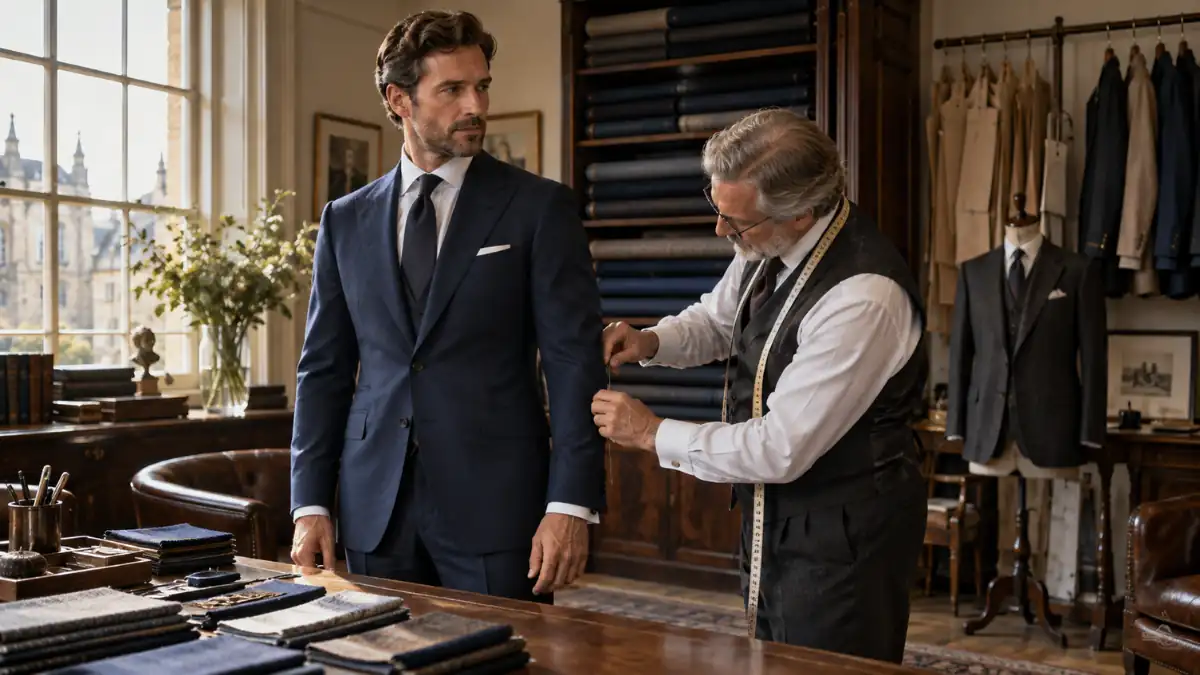
Bespoke tailoring is also a process rather than a single measurement appointment. Intermediate fittings allow the tailor to assess how the cloth behaves once it begins to take three-dimensional form around your body.
Consequently, decisions can be refined as the suit develops rather than relying entirely on measurements taken at the beginning.
Greater design control
Lapel width, buttoning position, pockets, vents, trouser rise, pleats, waistband treatments, lining, buttons and many other details can usually be discussed with your tailor.
However, good tailoring is not about choosing every unusual option available. In many cases, restraint produces the most useful suit. An experienced tailor should help you choose details that suit your build, wardrobe and intended use.
Does wearing a bespoke suit really make a difference?
Often, yes — although the difference is more subtle than simply looking expensive.
Well-fitted tailoring can improve the visual balance of the body. Jacket length, shoulder expression, waist suppression, sleeve pitch and trouser proportions all affect how coherent the finished silhouette appears.
Just as importantly, a correctly balanced jacket should feel comfortable when you stand, sit and move. Good tailoring is therefore not purely cosmetic.
This is why fit should be assessed across the entire garment rather than concentrating on how tightly the jacket follows the torso. Our guide to recognising correct jacket and trouser fit explains the important areas in more detail.
Good fit does not mean an excessively tight suit
Modern fashion has sometimes encouraged very close-fitting tailoring. Yet a quality suit needs enough room for the cloth to hang properly and for the wearer to move naturally.
A skilled tailor considers proportion and balance, not merely how much fabric can be removed.
Bespoke vs made-to-measure suits: which offers better value?
Neither option is automatically the correct choice for everybody.
Made-to-measure normally begins with an established pattern or block that is modified according to the customer’s measurements. Bespoke traditionally provides greater freedom because the pattern is developed specifically for the individual.
That additional freedom is particularly useful when standard patterns consistently create fitting problems. However, someone with relatively straightforward proportions may obtain an excellent result from a strong made-to-measure programme at a lower cost.
Therefore, the sensible comparison is not simply “which is better?” but rather “how much additional value will the bespoke process provide for me?”
We examine the structural differences more closely in our guide to choosing between the two principal custom-tailoring approaches.
Are bespoke suits full canvas and hand sewn?
Construction is one of the areas where shoppers can easily become overwhelmed by tailoring terminology.
In traditional high-level bespoke tailoring, a jacket will generally use a canvas structure rather than relying on a fully fused construction. Canvas helps give the chest and lapel shape while allowing the front of the jacket to develop naturally with wear.
There can also be substantial hand work in areas where the tailor wants greater control over shape, flexibility or finishing.
However, it is worth avoiding the assumption that the simple quantity of hand stitching determines whether a suit is good. What matters is whether the techniques used improve the structure, comfort, appearance or longevity of the garment.
Does hand sewing automatically make a suit superior?
Not necessarily. A poor hand stitch remains poor workmanship, while an accurately executed machine stitch can be entirely appropriate in parts of a garment.
Traditional tailoring uses hand work selectively because certain operations allow greater control when performed by an experienced craftsperson. The resulting value comes from skill and purpose, rather than hand sewing for its own sake.
You can explore cloth choice separately in our guide to understanding weight, weave and material for tailoring.
Unsure whether bespoke is the right level of tailoring for you?
Tell us how often you wear suits, the fit problems you normally encounter and what you want from the finished garment. We can help you understand which approach makes sense.
Are expensive bespoke suits worth the money?
This is where the question becomes personal. A bespoke suit cannot be judged purely by its purchase price because two clients may obtain very different value from exactly the same garment.
Quick value snapshot
- Initial cost: higher than most ready-to-wear and many made-to-measure options.
- Time commitment: expect measurements, discussions and several stages before completion.
- Fit potential: considerably greater scope to accommodate posture and individual proportions.
- Personalisation: extensive choice of cloth, cut, details and finishing.
- Long-term value: strongest when the suit is versatile, worn regularly and properly maintained.
One useful way to assess value is to consider cost per wear.
Imagine one beautifully made navy or charcoal suit becomes your default choice for important meetings, weddings, dinners and formal occasions over many years. Its initial price can make more sense when spread across frequent use.
Conversely, an extremely expensive suit bought for a single occasion may provide less practical value, regardless of how well it is made.
Fabric price is only one part of the equation
Premium cloth can increase the cost considerably, but the most expensive fabric is not necessarily the best everyday choice.
Very fine cloths can feel exceptionally luxurious, whereas more robust worsted wools may prove more practical for regular business wear and travelling.
If durability and versatility matter to you, our practical overview of materials used for quality suits will help you compare the main options.
Who is a bespoke suit most worthwhile for?
Bespoke tends to make the strongest case for buyers who recognise one or more of the following priorities.
You regularly struggle with ready-to-wear fit
Perhaps jackets fit across your chest but not your shoulders. Maybe trousers that accommodate your thighs are much too large at the waist. Alternatively, posture or asymmetry may make standard suits sit awkwardly.
These are precisely the situations where an individually developed garment can provide meaningful benefit.
You wear suits frequently
Regular business wear gives you more opportunity to benefit from comfort, cloth performance and fit. It also makes it easier to justify investing in versatile colours and fabrics that can form the foundation of a tailored wardrobe.
You care about proportion rather than trends
A bespoke commission allows you to build a suit around your proportions instead of following whichever extreme silhouette happens to be fashionable that season.
Choosing a restrained colour can also make the finished garment easier to wear. Our guide to versatile suit colours and when to wear them provides a useful starting point.
You appreciate the craft itself
For some clients, part of the value is simply enjoying the process: examining cloth, discussing style, seeing the first basted garment and working with a tailor who gradually learns their preferences.
That is difficult to represent on a conventional price comparison, yet it is a genuine part of why many clients return to bespoke tailoring.
How does the bespoke suit process add value?
Understanding the stages makes it much easier to see why genuine bespoke tailoring costs more than taking a finished suit from a rail.
Bespoke value checklist: what should happen during the process?
- Initial consultation: your tailor should establish how the suit will be worn, your preferred style and the practical requirements of your wardrobe.
- Cloth selection: fabric should be chosen according to climate, frequency of wear, formality and personal preference rather than price alone.
- Measurement and observation: the tailor considers measurements alongside stance, posture and body balance.
- Individual pattern development: the garment is developed for your proportions rather than simply selecting a standard finished size.
- Initial fitting: the partially constructed suit allows important balance and proportion changes to be assessed.
- Further refinement: subsequent fittings provide opportunities to improve sleeve position, trouser balance, jacket suppression and other details.
- Final finishing: construction and finishing details are completed after the major fitting decisions have been resolved.
- Aftercare: a good tailoring relationship should continue after collection if minor adjustments or maintenance become necessary.
Our separate guide to recognising the characteristics of genuine bespoke workmanship explains what you should look for when comparing tailoring services.
When might a bespoke suit not be worth it?
Bespoke is not automatically the sensible purchase simply because it represents the highest level of customisation.
A different option may suit you better when:
- you wear a suit only once every few years;
- you need the garment within a very short deadline;
- your budget would make you uncomfortable throughout the buying process;
- you are still experimenting heavily with your preferred style;
- a well-cut ready-to-wear suit already fits your proportions extremely well; or
- a good made-to-measure service can address the adjustments you actually need.
In those circumstances, spending less does not mean settling for a poor suit. It may simply represent a more proportionate way of meeting your needs.
FAQs: are bespoke suits worth it?
Are bespoke suits actually worth it?
They can be, particularly if you wear tailoring regularly, struggle with standard sizing or place a high value on fit, comfort, craftsmanship and personal choice. If you rarely wear suits and ready-to-wear already fits you well, the additional investment may be less important.
Are bespoke suits expensive?
Bespoke tailoring usually costs substantially more than mass-produced ready-to-wear because it involves skilled labour, fitting time, individual pattern work, construction and finishing. However, price varies considerably between tailors, locations, fabrics and methods of construction.
Why are bespoke suits so expensive?
Much of the additional cost comes from labour and time. A genuine bespoke garment requires individual cutting, fitting and construction rather than high-volume production based around standard sizes. Premium cloth and specialist hand finishing can increase the cost further.
Are bespoke suits better than made-to-measure?
Bespoke offers greater freedom to develop the pattern around an individual body, whereas made-to-measure normally modifies an existing pattern. That does not mean bespoke is always the better purchase. A well-executed made-to-measure suit can provide excellent results for someone whose proportions work well with the underlying pattern.
Are bespoke suits full canvas?
Traditional high-quality bespoke jackets commonly use a full canvas construction, although the exact method should always be confirmed with the individual tailor. Construction standards can vary between businesses that use the term “bespoke”.
Are bespoke suits hand sewn?
High-level traditional bespoke tailoring can involve a considerable amount of hand work, especially where hand techniques help the tailor shape or finish the garment. However, machine stitching may still be used where appropriate. The quality and purpose of the workmanship matter more than simply counting stitches.
How can you tell if a suit is truly bespoke?
Ask how the pattern is created, how many fittings are normally provided, where the garment is cut and made, and how much freedom exists to alter the underlying shape of the suit. Genuine bespoke should involve considerably more than selecting cloth and adjusting a standard-size garment.
Does wearing a better-fitting suit really make a difference?
Fit affects both appearance and comfort. Correct jacket balance, shoulder position, sleeve length, trouser rise and overall proportion can create a cleaner silhouette while allowing natural movement. The result should look harmonious rather than simply tight.
Where are the best bespoke suits made?
Excellent bespoke tailoring traditions exist in several countries and cities, including Britain and Italy, as well as highly skilled tailoring centres elsewhere in Europe and Asia. Rather than choosing solely by geography, look at the individual house's cutting style, construction, fitting process and reputation for consistent workmanship.
What are bespoke suits usually made from?
Wool remains one of the most important suiting materials because different weights and weaves can provide excellent drape, resilience and comfort. Linen, cotton, cashmere and blends can also be appropriate depending on climate, season and how the garment will be worn.
Still deciding between bespoke and another tailoring option?
We can talk through your wardrobe, preferred fit, budget and how often you expect to wear the suit before you commit.
Next steps & useful guides
If you are considering commissioning a suit, these related Stunning Fashion guides will help you understand the choices before your first appointment:
- Understand the complete traditional tailoring process
- Learn how to identify genuine craftsmanship
- Compare the two principal forms of custom tailoring
- Check the important signs of correct suit fit
- Understand suit cloth, weight and weave
- Choose a versatile colour for your wardrobe
- Biggest benefit A suit developed around your individual body, posture, proportions and style preferences.
- Best suited to Regular suit wearers, difficult-to-fit body shapes and clients who value craftsmanship and personalisation.
- Main alternative Made-to-measure, which generally modifies an established pattern and can offer excellent value for straightforward fitting requirements.
- Construction Traditional high-level bespoke commonly uses canvassed construction together with skilled hand work where it contributes to shaping and finishing.
- Time required More than ready-to-wear because consultations, pattern work and repeated fittings form part of the process.
- Long-term value Usually strongest when you choose a versatile cloth and style, wear the garment regularly and maintain it carefully.
- What to verify Ask how the pattern is created, how many fittings are included, how the jacket is constructed and where the garment is made.
Thinking about your first commission? Speak to Stunning Fashion about the right tailoring approach for you.
So, is a bespoke suit worth the investment?
Ultimately, are bespoke suits worth it is not a question that can be answered by price alone.
The strongest argument for bespoke is the combination of fit, craftsmanship, choice and personal service. When those things matter to you — and when you intend to wear the garment enough to enjoy them — the additional investment can be entirely rational.
However, bespoke should never be purchased simply because it is the most expensive option. A successful commission begins with understanding what you need and choosing a tailor whose approach suits your body, wardrobe and expectations.
At Stunning Fashion, we believe excellent tailoring should feel considered rather than complicated. Our role is to help you understand your options, choose sensibly and create clothing that looks natural on you rather than clothing that merely announces how much it cost.
Considering a bespoke suit?
Speak with Stunning Fashion about fit, fabric, style and the type of tailoring that will give you the most useful result.
