Share this post:
Quick summary: What Is a Bespoke Suit?
If you are asking What Is a Bespoke Suit, the simplest answer is this: it is a suit created specifically for one individual rather than adapted from a standard factory pattern. Your tailor takes detailed measurements, studies your posture and proportions, creates an individual pattern, cuts your chosen cloth and refines the garment through a series of fittings.
- Individual pattern: the starting pattern is created for you rather than selected from a predetermined size range.
- Personal design: proportions, lapels, pockets, buttons, lining, trouser shape and other details can be chosen around your preferences.
- Multiple fittings: the garment is normally assessed and adjusted while it is being made rather than simply altered after completion.
- Skilled construction: genuine bespoke tailoring involves considerable specialist cutting, fitting and hand-finishing.
- Designed around the wearer: the goal is not merely to make a suit tighter or looser, but to create balance, comfort and proportion for your particular body.
That distinction matters because the word “bespoke” is sometimes used loosely. A good buyer should therefore look beyond the label and ask how the pattern is created, where the garment is cut and made, how many fittings are provided and who is responsible for correcting the fit.
Considering commissioning a suit for yourself?
Tell our team how you intend to wear it, the climate you live in and the style you prefer. We can explain the choices that matter before you commit.
What Is a Bespoke Suit – and what does “bespoke” really mean?
A genuinely bespoke garment begins with the wearer rather than with an existing size. Instead of taking a standard 40, 42 or 44 jacket and altering it, the cutter considers your measurements, posture, shoulder position, balance and physical proportions before creating a pattern specifically for you.
That difference is fundamental. Tailoring is not simply about making clothing slimmer. A well-cut garment must balance properly around the body, hang cleanly and allow you to move naturally.
Traditional British tailoring also places considerable importance on the relationship between cutter and client. Measurements are only part of the information required. An experienced cutter observes how you stand, whether one shoulder sits lower, how your arms fall, where your waist naturally sits and how you prefer your clothing to feel.
For a deeper look at the standards we believe buyers should examine, read our guide to how we assess genuine hand-cut tailoring.
What makes a bespoke suit genuinely bespoke?
There is no single detail that proves quality. Instead, you should consider the complete process. In traditional tailoring, several elements work together.
An individual pattern
The pattern is the blueprint from which the cloth is cut. With true bespoke work, it is drafted specifically around your body and can then be developed further as the fittings reveal how the cloth behaves on you.
This matters because two people with an identical chest measurement may have completely different proportions. One may stand very upright, while another has a forward shoulder. One may need additional length over the front of the jacket, while another requires a different balance through the back.
Cloth cut specifically for you
Once the pattern is established, your chosen cloth is individually cut. The cutter also considers checks, stripes and other patterns so that visual lines can be positioned attractively across the garment.
Fittings during construction
One of the clearest differences between high-level bespoke work and ordinary alterations is that adjustments take place while the garment is still being constructed.
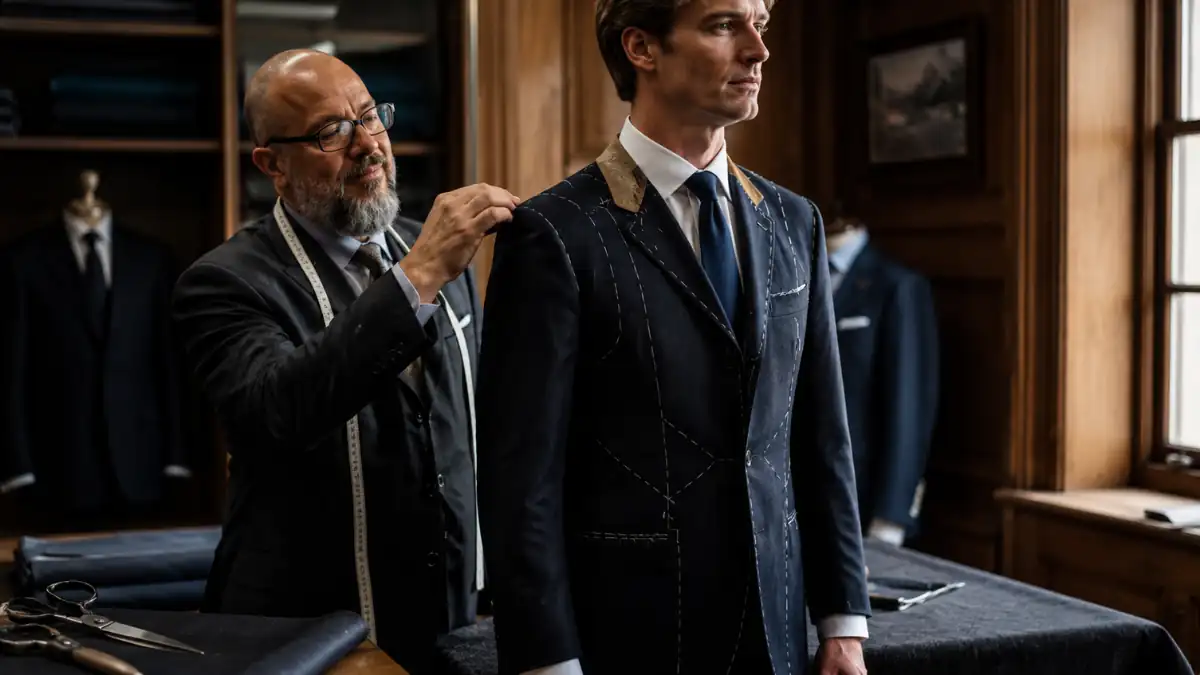
During an early fitting, for example, the jacket may still be in a temporary basted state. That allows the cutter to alter balance, length, suppression, shoulder position and other aspects before everything is permanently finished.
Substantial skilled handwork
Handwork should have a purpose. It can help a skilled maker shape cloth in ways that are difficult to reproduce through simple mass-production techniques, particularly around areas such as the chest, lapel and collar.
However, visible hand-stitching by itself does not automatically make an excellent garment. Pattern cutting, balance, fit and construction are more important than decorative signs of craftsmanship.
Bespoke suit vs made-to-measure vs ready-to-wear
This is where many buyers become confused, because all three routes can produce attractive clothing. The difference lies mainly in how the garment begins and how extensively it can be adapted.
Ready-to-wear
Ready-to-wear clothing is produced in predetermined sizes. You choose the closest size and an alterations tailor may then adjust areas such as sleeve length, trouser length or waist suppression.
Good ready-to-wear can look excellent when your proportions suit the house block. However, there are limits to what alterations can realistically correct.
Made-to-measure
Made-to-measure usually begins with an existing base pattern or block. Measurements are taken and that established pattern is adjusted before the garment is manufactured.
Modern made-to-measure can offer very good results, particularly for people whose proportions sit reasonably close to the manufacturer's underlying block. It can also provide substantial choice in cloth, lining, buttons and styling.
Bespoke
With traditional bespoke work, the process starts more fundamentally from the individual. A personal pattern is created, cloth is cut for that person, and the fit is developed through successive stages.
Quick comparison
| Feature | Ready-to-wear | Made-to-measure | Traditional bespoke |
|---|---|---|---|
| Starting point | Finished standard size | Existing pattern adjusted | Individual pattern |
| Fit adjustment | After manufacture | Measurements applied before manufacture | Developed during construction |
| Design freedom | Limited | Usually extensive | Very extensive |
| Fittings | Alterations fitting if required | Varies by maker | Series of fitting stages |
None of these approaches is automatically right or wrong. The better question is whether the service matches your body, expectations, budget and intended use.
You can explore the wider subject in our complete tailoring overview.
The bespoke suit process: what happens step by step?
Every tailoring house has its own working methods. Nevertheless, a traditional commission normally follows a recognisable sequence.
Step-by-step tailoring checklist
- Initial consultation. You discuss the purpose of the garment, preferred style, climate, wardrobe and how frequently it will be worn.
- Cloth selection. The tailor helps you choose an appropriate fibre, weave, weight and colour rather than focusing on appearance alone.
- Measurements and observation. Measurements are recorded while posture, shoulder position and overall balance are assessed.
- Pattern drafting. A personal pattern is created for the commission.
- Cutting. The cloth is laid out and cut according to that pattern.
- First fitting. An unfinished or basted garment allows the cutter to assess proportion and make meaningful corrections.
- Further fitting. Adjustments are refined as the jacket and trousers move closer to their final construction.
- Finishing. Buttonholes, pressing, lining, edges and other finishing work are completed.
- Final assessment. The completed garment is checked on you and small finishing alterations are made if required.
A useful illustration of this traditional sequence can also be found in Henry Poole & Co.'s description of its house process.
Not sure which level of tailoring is right for you?
We can help you think through fit, cloth, construction, occasion and budget before you decide how far you need to go.
What does a bespoke suit look like when it fits properly?
The best result should not announce itself through extreme tightness. Instead, it should make the wearer look balanced, comfortable and composed.
Around the shoulders, the jacket should sit cleanly without obvious collapsing, pulling or unnecessary overhang. The collar should remain close to the shirt collar, while the front and back lengths should work with your proportions.
Through the chest and waist, there should be enough shape to create definition without restricting breathing or movement. Meanwhile, the sleeves should hang cleanly and allow an appropriate amount of shirt cuff to show.
Trousers deserve equal attention. Rise, seat, thigh width and hem all influence how elegant the full outfit appears.
For more detail, see our guide to judging jacket fit and overall proportion and our separate explanation of getting trouser proportions right.
Fabric, construction and style choices
Cloth selection has a major effect on how a suit performs. Weight, weave, fibre and finish influence drape, breathability, durability and how sharply the garment holds its shape.
Wool
Wool remains one of the most versatile choices for tailored clothing. Different weights and weaves allow it to work across formal business clothing, travel wardrobes, evening wear and warmer climates.
The Woolmark Company provides useful background on how wool behaves in tailored clothing.
Linen
Linen is particularly attractive in warm conditions. It has a relaxed character and naturally develops creasing during wear, which should be regarded as part of its appearance rather than necessarily a fault.
Cotton
Cotton can work well for less formal tailoring and warmer-weather wardrobes. It usually creates a different drape from worsted wool and can look more relaxed.
Cloth weight matters as much as fibre
A buyer should therefore avoid choosing fabric solely because it feels exceptionally fine in the hand. Your lifestyle, climate and frequency of wear are equally important.
Our guide to choosing cloth for comfort, drape and durability explains this subject in greater depth.
Personal style choices
You can normally discuss details such as:
- single-breasted or double-breasted fronts,
- notch or peak lapels,
- lapel width,
- jetted, flap or patch pockets,
- single or double vents,
- trouser pleats,
- side adjusters or belt loops,
- button material,
- lining choices, and
- hand-finishing details.
The value of an experienced tailor lies partly in restraint. Rather than adding every possible option, a good professional should help you create a coherent garment that suits your body and intended use.
How much does a bespoke suit cost?
There is no meaningful universal average because pricing varies considerably between countries, tailoring houses, cloths and levels of construction.
Quick cost snapshot
- Price should reflect the process: cutting, fittings, construction and specialist labour all require substantial time.
- Cloth affects price: rare fibres, luxury mills and very fine fabrics may increase the commission considerably.
- Three-piece garments cost more: adding a waistcoat involves additional cloth and workmanship.
- Location matters: labour costs and workshop structures vary from London to other tailoring centres around the world.
- House reputation matters: established workshops with highly experienced cutters may command a significant premium.
At the upper end of the market, traditional Savile Row commissions are substantial purchases. Therefore, rather than comparing price alone, ask exactly what is included in the service.
Are bespoke suits worth it?
For the right client, they can be. However, the value depends on why you are commissioning one.
It may be worthwhile when fit is difficult
If ready-made clothing consistently creates problems around the shoulders, posture, chest, seat or leg balance, a personal pattern gives the tailor much greater freedom to work with your proportions.
It can make sense when you wear tailoring frequently
Someone who wears a suit once every few years may not receive the same value as a person who uses tailored clothing every week.
It suits clients who care about design
The process can also be rewarding when you know what you like and want control over proportions, cloth and details that are difficult to find in ready-made collections.
It may not be necessary for everyone
If a good ready-to-wear block fits you exceptionally well, or a quality made-to-measure service can accommodate your requirements, paying for the highest level of individual construction may not be necessary.
How to choose a bespoke tailor
The relationship matters because you are relying on the cutter not only to measure you but also to interpret your preferences.
Ask who will cut your pattern
UKFT describes a bespoke cutter as the specialist artisan responsible for creating the pattern and cutting a tailored garment for an individual. You can read its description of the cutter's professional role.
Ask where the garment is made
There is nothing inherently wrong with a workshop using specialist makers elsewhere. However, you should know what you are buying. Ask whether cutting, coat-making, trouser-making and finishing are completed in-house or by external craftspeople.
Ask how many fitting stages are included
The exact number varies between houses and commissions. More important than chasing a specific number is understanding whether the tailor can make meaningful adjustments while the garment is still under construction.
Look at the house style
Tailors often have recognisable approaches to shoulders, chest structure, waist suppression and trouser shape. Choose a house whose natural aesthetic is reasonably close to what you want.
Pay attention to the consultation
A good tailor should ask how and where the garment will be worn. Climate, profession, travel and frequency of use all influence sensible recommendations.
The Savile Row industry's tailoring terminology is also useful when comparing the language used by different makers.
What does a bespoke suit mean for different types of client?
For men
The traditional process can accommodate differences in shoulder position, chest shape, waist, seat and leg balance while also allowing the client to choose a more classical, contemporary or relaxed silhouette.
For women
The same principles apply. Individual cutting can be particularly valuable when standard women's tailoring fails to accommodate a client's preferred balance between waist definition, bust shaping, jacket length and trouser proportions.
For weddings and formal occasions
A wedding commission benefits from planning well in advance. This gives sufficient time for fittings and helps avoid choosing cloth or styling purely for one day's photographs when the garment could remain useful afterwards.
For business and frequent travel
Durability, crease recovery, practical pockets and climate suitability often matter more than exceptionally delicate cloth. A regular traveller may therefore benefit from a different fabric recommendation from someone commissioning an occasional evening suit.
Common mistakes when commissioning your first suit
- Choosing cloth by softness alone. Very fine does not always mean more practical.
- Requesting an excessively tight fit. Tailored clothing still requires movement and ease.
- Copying a photograph exactly. Proportions that work on somebody else may not flatter your frame.
- Adding too many distinctive details. Restraint usually makes an expensive garment more versatile.
- Focusing on brand name rather than cutter relationship. The person interpreting your body and preferences is extremely important.
- Leaving too little time. Individual tailoring should not be treated like an emergency purchase.
- Ignoring shirts and trousers. A beautifully fitted jacket cannot compensate for a poorly fitting shirt or badly balanced trousers.
For the shirt underneath, our guide to shirt fit, fabric and styling choices will help you build the complete outfit rather than looking at the jacket in isolation.
FAQs: What Is a Bespoke Suit?
What exactly is a bespoke suit?
It is a tailored garment created individually for one client. In the traditional process, a personal pattern is drafted, cloth is cut specifically for the wearer and fit is refined through several stages while the garment is being made.
What does bespoke suit mean?
In tailoring, the term generally describes clothing commissioned for an individual rather than selected from predetermined finished sizes. However, because the word is used quite broadly in modern marketing, buyers should always ask how the pattern, cutting and fitting process actually works.
What makes a suit genuinely bespoke?
Look for an individual pattern, personal cutting, meaningful fitting stages, skilled construction and the ability to alter the balance of the garment during manufacture. The process is more revealing than the label on the receipt.
How many fittings are needed?
There is no single number that applies to every tailoring house or every client. Traditional commissions normally involve a series of fittings, with additional work where required. What matters is that the cutter has sufficient opportunity to assess and correct the developing garment.
What is made-to-measure vs bespoke?
Made-to-measure normally alters an existing base pattern according to your measurements. Traditional bespoke starts with a pattern created for the individual and develops the fit through the construction process.
What is a custom-made suit?
“Custom-made” is a broad term and does not describe one universally consistent manufacturing method. A custom garment could be made-to-measure, individually patterned or produced using another system. Ask the maker to explain the process rather than relying on the word itself.
How much is a bespoke suit?
Prices vary enormously according to country, tailoring house, cloth, construction and reputation. Genuine individual tailoring is labour-intensive, so compare exactly what the quoted price includes rather than looking for a universal average.
Is a bespoke suit worth it?
It can be worthwhile if you struggle with standard sizing, wear tailoring frequently, value an individual design or simply appreciate traditional craftsmanship. If good ready-to-wear already fits you extremely well, the additional expense may be less important.
What does a well-tailored suit look like?
It should appear balanced rather than merely tight. The collar sits cleanly, the shoulders look controlled, the jacket hangs naturally, the chest has room to move and the trousers fall cleanly through the leg.
Can women have fully bespoke tailoring?
Yes. Individual pattern cutting is applicable to women's tailoring as well as men's, and can be used for suits, jackets, trousers, coats and formal clothing.
What is a bespoke three-piece suit?
It normally consists of a jacket, matching trousers and a waistcoat commissioned as one outfit. Because the waistcoat introduces another fitted garment, its proportions should be considered together with the jacket and trouser rise.
Can a coat be made using the same process?
Yes. Individual tailoring is not limited to two-piece business suits. Tailors may also produce coats, jackets, dinner suits, morning wear, trousers and other garments using the same principles of personal cutting and fitting.
Still comparing tailoring options?
Tell us what you want the garment to achieve and we can help you identify the questions worth asking before choosing a tailor.
Next steps & useful guides
If you are considering your first commission, these related guides will help you examine the areas that matter most:
- Learn how we identify genuine individual tailoring
- Explore our wider guide to commissioning tailored clothing
- Check the key signs of correct jacket fit and balance
- Understand how well-cut trousers should sit and fall
- Compare cloth by weight, drape, climate and durability
- Build the outfit around a properly fitted shirt
- Starting point An individual client's body and requirements rather than a finished standard size.
- Pattern Traditional bespoke work uses a pattern created specifically for the wearer.
- Fittings The fit is developed through a series of fitting stages while the garment is being constructed.
- Main advantage Greater control over fit, balance, proportion, styling and cloth selection.
- Made-to-measure difference Made-to-measure normally adapts an existing base pattern; traditional bespoke starts with an individually drafted pattern.
- Best buying question Ask how the pattern is made, who cuts the cloth, how fittings work and where the garment is constructed.
- Price Varies substantially by tailoring house, location, cloth, construction and level of craftsmanship.
- Worth it? Potentially, especially where fit, individuality, regular use and craftsmanship matter to the buyer.
Considering a commission? Contact Stunning Fashion and tell us what you are looking for.
Independent tailoring resources
If you want to research the craft further, these specialist organisations and established tailoring resources provide useful additional reading:
- Savile Row industry terminology and traditional tailoring definitions
- UK Fashion and Textile Association explanation of the cutter's role
- Woolmark guidance on wool for tailored clothing
- A traditional Savile Row house's step-by-step making process
Understanding what you are really paying for
A quality tailoring commission is ultimately about more than measurements. The cutter is trying to translate your body, posture, lifestyle and preferences into cloth while maintaining balance, comfort and proportion.
That is why two suits labelled “custom” can be very different products. One might adapt a standard block efficiently and produce an excellent result. Another might involve an individually drafted pattern, repeated fitting stages and many hours of specialist work.
Neither price nor marketing terminology should make the decision for you. Instead, establish how the garment will be created, who will take responsibility for the fit and whether the tailor's natural style matches what you actually want to wear.
At Stunning Fashion, we believe a Quality Client should understand those differences before spending significant money. Once you understand the process, you can judge tailoring on substance rather than simply on labels.
Ready to discuss your next tailored garment?
Speak with Stunning Fashion about your fit, preferred style, cloth, occasion and expectations, and we will help you approach your commission with confidence.
