Share this post:
Quick summary: tailored shirts
Tailored shirts are designed to sit cleanly across your shoulders, chest, waist and sleeves without feeling restrictive. Unlike a standard off-the-rack shirt, a properly tailored shirt considers your individual proportions, posture and preferred level of ease.
- Ready-to-wear tailored fit describes a standard, shaped cut and is not made specifically for you.
- Made-to-measure shirts begin with an existing pattern that is adjusted using your measurements.
- Bespoke shirts are created from an individual pattern and allow greater control over fit, fabric and finishing.
- Good fit matters more than a tight silhouette. A quality shirt should follow your shape while still allowing comfortable movement.
- Fabric, collar construction and craftsmanship affect how the shirt feels, performs and looks over time.
The right choice depends on how often you wear shirts, the formality of your wardrobe and whether standard sizing works for your body. This guide explains the differences clearly so that you can choose a shirt with confidence.
Looking for a shirt that fits properly?
Speak with our team about your measurements, wardrobe and preferred style before deciding between ready-to-wear, made-to-measure and bespoke.
What are tailored shirts?
The phrase “tailored shirt” is used in several different ways. Some retailers use it to describe a shaped ready-to-wear shirt. A shirtmaker, however, may use the term for a garment adjusted or produced around an individual client.
Therefore, it is important to look beyond the label. A shirt described as tailored fit may still be manufactured in standard sizes, whereas a made-to-measure or bespoke shirt involves personal measurements and a more considered fitting process.
At its best, shirt tailoring creates balance. The collar sits comfortably. The shoulder seams follow your natural shoulder line. Meanwhile, the body remains neat without pulling across the chest or ballooning around the waist.
Why fit changes the appearance of a shirt
A shirt covers much of the upper body, so small fit problems become visible quickly. Excess fabric at the waist can make an otherwise elegant outfit appear untidy. Equally, a shirt that is too tight can pull between the buttons and restrict movement.
Proper tailoring aims to remove unnecessary cloth while preserving comfort. As a result, the shirt looks cleaner both on its own and beneath a jacket.
Tailored shirts compared with standard shirts
Standard shirts are produced for general body shapes. They offer convenience and may fit very well when your proportions are close to the manufacturer’s block. However, difficulties arise when your neck, chest, waist, arms and shoulders do not correspond neatly with one size.
Tailored fit versus regular fit
A regular-fit shirt normally provides more room through the chest and waist. By comparison, a tailored-fit shirt is shaped closer to the torso, often with narrower sleeves and more suppression at the waist.
Nevertheless, retailer terminology is inconsistent. One brand’s tailored fit may resemble another brand’s slim fit. For that reason, the actual garment measurements are more useful than the wording on the label.
Tailored fit versus slim fit
Slim-fit shirts are usually cut close throughout the body and sleeves. A tailored fit may provide a shaped waist while retaining slightly more room across the chest and upper arms.
Neither fit is inherently better. The correct option is the one that follows your proportions without visible strain. In particular, a broad chest and smaller waist may require shaping rather than simply choosing the tightest available shirt.
Tailored shirts versus untailored shirts
An untailored shirt may hang straight from the chest, producing excess material around the lower torso. A tailored version introduces shape through its side seams, darts or pattern construction.
However, tailoring should remain subtle. The goal is not to create a skin-tight garment. Instead, the shirt should appear composed when you are standing, sitting and moving.
The different levels of tailored shirtmaking
Shirtmaking is better understood as a spectrum rather than a simple choice between shop-bought and bespoke. Each level can be appropriate, depending on your budget, proportions and expectations.
Ready-to-wear tailored shirts
Ready-to-wear shirts are made in predetermined sizes and fits. You can try them immediately, compare different brands and leave with a finished garment.
They are often the most practical choice when standard sizing suits you. In addition, minor alterations may improve the result, particularly around the waist or sleeve length.
Their main limitation is that one size must accommodate several measurements at once. For example, choosing a shirt that fits your neck may leave too much fabric around your waist.
Altered ready-to-wear shirts
A standard shirt can sometimes be refined by a skilled alterations tailor. Common adjustments include shortening sleeves, reducing the body through the side seams or adding darts.
Yet alterations have limits. Shoulder width, armhole position and collar size are difficult or uneconomical to reconstruct. Consequently, the original shirt must already fit reasonably well in these areas.
Made-to-measure shirts
Made-to-measure begins with an established base pattern. The shirtmaker then modifies selected dimensions using your measurements and fitting preferences.
This method normally offers choices of fabric, collar, cuff, buttons and monogramming. It can also accommodate differences such as one shoulder sitting lower than the other, although the available adjustments depend on the maker.
Made-to-measure is often a sensible middle ground. It provides more personalisation than ready-to-wear without requiring the full pattern-cutting process associated with bespoke work.
Bespoke tailored shirts
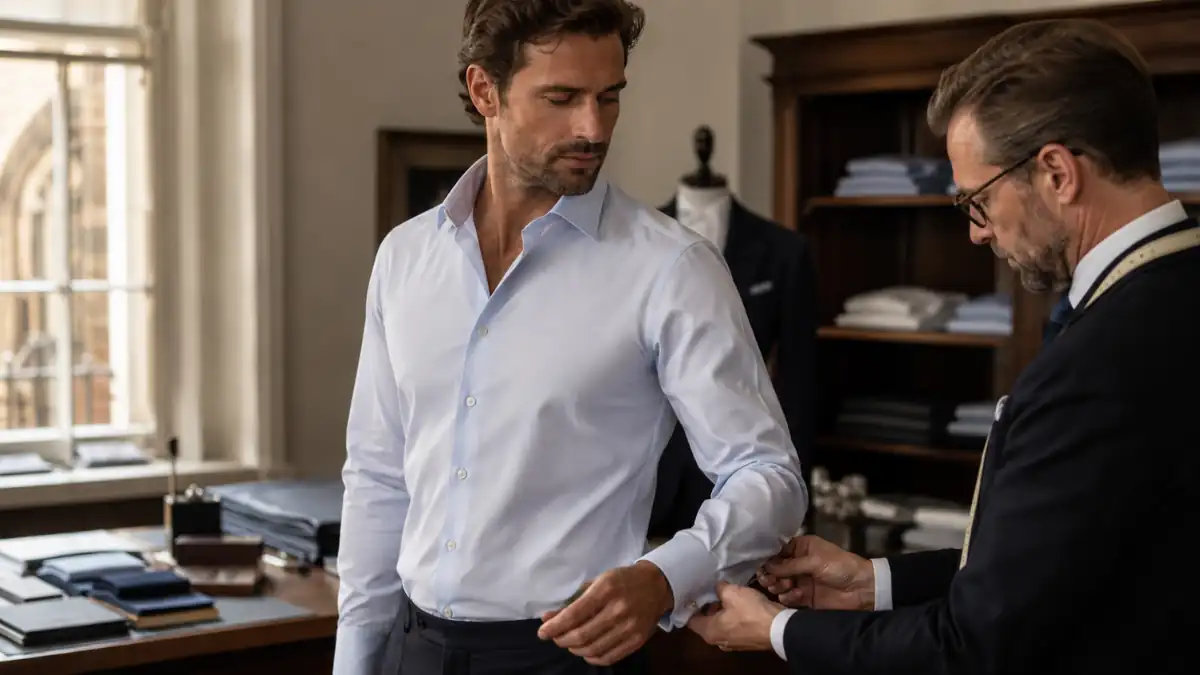
A bespoke shirt is produced from a pattern created for the individual client. This allows the cutter to consider measurements, posture, shoulder position and the way the client prefers the shirt to feel.
The process may involve a trial garment or fitting before the final shirt is completed. Moreover, the pattern can be refined over subsequent orders as the shirtmaker learns how the cloth behaves on the wearer.
Bespoke is especially valuable for clients who struggle with standard proportions, require specific comfort adjustments or want detailed control over the finished garment.
The principles behind individual patterns and skilled handwork also apply across traditional tailoring. Our guide to how genuine bespoke tailoring is recognised explains what separates a personalised garment from one produced to a standard block.
How should a tailored shirt fit?
Good fit is assessed as a complete system. Changing one area can influence another, so measurements should not be considered in isolation.
Collar fit
When buttoned, the collar should sit evenly around the neck without pinching. You should be able to turn your head comfortably, and the collar should not leave a pronounced gap at the back.
A collar that is too loose can sit untidily beneath a tie or jacket. Conversely, an overly tight collar becomes uncomfortable quickly and may distort the front of the shirt.
Shoulder fit
The shoulder seam should finish close to the point where your shoulder ends and your arm begins. When it falls too far down the arm, the shirt can look oversized. When it sits too far inwards, the upper body may feel restricted.
Shoulder fit is especially important because it is one of the least straightforward areas to alter successfully after manufacture.
Chest and upper back
The chest should contain enough ease for breathing and movement. There should be no persistent horizontal pulling between the buttons.
At the back, a little room is necessary to allow your arms to move forwards. Depending on your shape and preferences, the shirtmaker may use a centre box pleat, side pleats or a clean back without pleats.
Waist and seat
A well-shaped waist gives the shirt its clean line. However, it should not cling to the stomach or pull when you sit.
The lower part of the shirt also needs enough room over the hips and seat. This is particularly important when the shirt will remain tucked into trousers throughout the day.
Sleeve and cuff length
The sleeve should contain sufficient length to remain comfortable when the elbow bends. When worn with a tailored jacket, a modest amount of shirt cuff will usually remain visible below the jacket sleeve.
Meanwhile, the cuff should be secure without squeezing the wrist. A watch may require slightly more room on one side, which can be incorporated into a personalised order.
Shirt length
Formal shirts are normally longer because they are intended to stay tucked in. Casual shirts designed to be worn untucked require a shorter, carefully judged hem.
A shirt that is too short may work loose during normal movement. On the other hand, excessive length creates unnecessary bulk inside the trousers.
Tailored shirt fitting checklist
- Button the collar. Check that it sits evenly and remains comfortable when you turn your head.
- Inspect the shoulders. The seams should follow the ends of your natural shoulders.
- Look for pulling. Persistent strain across the buttons indicates insufficient room.
- Check the waist. The shirt should follow your outline without clinging.
- Move your arms. Reach forwards and upwards to test the back and armholes.
- Sit down. Make sure the body remains comfortable and does not pull across the stomach.
- Check the cuffs. They should stay in position while allowing normal wrist movement.
- Test the shirt with a jacket. Confirm that the collar, cuffs and body sit cleanly beneath tailoring.
Choosing fabric for tailored shirts
Fit attracts the most attention, but fabric determines much of the shirt’s comfort, appearance and practicality. Fibre, weave, weight and finish all influence the result.
Cotton shirts
Cotton remains a classic shirt material because it can be woven in many different weights and textures. Fine cotton may feel smooth and refined, while heavier cloth provides more structure.
Quality is not determined by thread count alone. The quality of the yarn, the construction of the cloth and its suitability for the intended use are equally important.
Poplin
Poplin has a smooth, closely woven surface and usually creates a crisp appearance. It works particularly well for business and formal shirts.
Because it is relatively smooth and lightweight, poplin can show creasing more readily than some textured weaves. Nevertheless, it remains an excellent option for a clean, polished wardrobe.
Twill
Twill is identified by its subtle diagonal texture. It generally drapes well, feels substantial and may resist visible creasing better than a very fine plain weave.
Fine twills suit professional dressing, while heavier versions can work for relaxed shirts. Their slight sheen can also add depth to solid colours.
Oxford cloth
Oxford cloth has a more noticeable basket-like texture. It is durable, relaxed and strongly associated with button-down shirts.
Traditional Oxford cloth is heavier than fine formal shirting. Therefore, it works well for smart-casual outfits, layering and regular wear.
Linen shirts
Linen is breathable and well suited to warm weather. Its natural creasing is part of its character rather than a defect.
A tailored linen shirt can still look refined, although the fit should allow for the fabric’s relaxed behaviour. Linen and cotton blends can offer a useful compromise between texture, coolness and easier care.
Flannel and brushed cotton
Brushed cotton and cotton flannel provide warmth and softness. These cloths are usually better suited to casual shirts, overshirts and colder weather.
Since heavier fabrics occupy more space, the pattern may require slightly different ease from a lightweight business shirt.
Pattern and colour
White and pale blue are versatile foundations. Fine stripes and restrained checks add variety while remaining easy to coordinate.
Larger checks, bold stripes and strong colours draw more attention. Accordingly, they are often most useful after the core wardrobe has been established.
Unsure which fabric or fit will suit you?
We can help you assess how the shirt will be worn, how formal it needs to appear and which details will provide lasting value.
Collars, cuffs and tailored shirt details
Personalisation should support the shirt’s purpose. Although a long list of options can be appealing, restraint usually creates the most versatile result.
Choosing a shirt collar
A point collar has relatively narrow spacing between its points and works with many business wardrobes. A spread collar opens more widely and can frame a larger tie knot or sit elegantly without a tie.
Cutaway collars make a stronger visual statement. Button-down collars, by comparison, feel more relaxed and work particularly well with Oxford cloth and smart-casual clothing.
Collar choice should also consider your face, neck and jacket lapels. A balanced collar complements the wearer rather than dominating the outfit.
Single cuffs and double cuffs
Button cuffs are versatile and practical for daily wear. They can be rounded, angled or square, although the difference is mainly visual.
Double cuffs, often called French cuffs, fold back and are secured with cufflinks. They are associated with more formal business and evening dress.
Plackets, pockets and back details
A visible front placket provides a familiar, slightly more structured appearance. A concealed or plain front can look cleaner and more formal.
Chest pockets are practical but generally make a shirt appear less formal. Likewise, back pleats increase movement, while darts create a closer shape through the waist.
Buttons and buttonholes
Button quality contributes to the feel and longevity of a shirt. Natural shell buttons are traditional, although high-quality synthetic buttons can also be durable and attractive.
Secure stitching, clean buttonholes and properly positioned buttons matter more than decorative claims. These details should remain neat after repeated washing and wear.
Monograms and initials
Initials can add a discreet personal detail. However, placement and colour should be considered carefully.
Subtle monograms placed on the cuff, lower body or inside the collar tend to feel more refined than prominent contrasting embroidery.
Tailored shirts for work, formalwear and casual dressing
Business shirts
A dependable professional wardrobe usually begins with white, pale blue and restrained striped shirts. Poplin and fine twill provide a polished appearance beneath a suit or tailored jacket.
The collar should sit cleanly beneath the jacket, while the cuff should remain visible without extending excessively. A balanced fit is especially important because the shirt must remain comfortable through a full working day.
Formal and evening shirts
Formal shirts may include a more structured collar, concealed front, double cuffs or a textured bib, depending on the dress code.
Eveningwear traditions are specific, so the shirt should be chosen alongside the dinner jacket, bow tie and waist covering rather than as an isolated garment.
Wedding shirts
A wedding shirt needs to look composed in photographs while remaining comfortable for many hours. Fabric opacity, collar shape and cuff style should be coordinated with the suit and accessories.
It is sensible to wear and launder the shirt before the event. This confirms comfort and allows any final adjustments to be made in good time.
Casual tailored shirts
Tailoring is not limited to formal clothing. Oxford shirts, linen shirts, denim shirts and overshirts can all benefit from considered proportions.
Casual shirts may be shorter, softer and more relaxed. However, the shoulders, sleeves and body should still relate properly to the wearer.
Tailored shirts with jeans
A shirt worn with jeans generally looks most natural when the fabric has some texture. Oxford cloth, linen, brushed cotton and chambray are particularly useful.
Very smooth formal poplin can work, but it may create a sharper contrast. Rolling the sleeves and wearing an open collar can make the outfit feel less formal.
For a broader understanding of how shirts fit into a complete tailored wardrobe, read our guide to bespoke suits and personal tailoring.
How to order a tailored shirt: step by step
A good commission starts with a clear conversation. Rather than focusing only on measurements, discuss how the shirt will be worn and what has gone wrong with previous shirts.
- Define the purpose. Decide whether you need shirts for business, travel, weddings, eveningwear or relaxed use.
- Review your existing wardrobe. Bring a shirt that fits well and another that demonstrates the problems you want to solve.
- Discuss your preferred fit. Explain whether you favour a close, balanced or more relaxed silhouette.
- Take measurements and assess posture. A good fitter will consider shoulder slope, stance and body balance as well as numerical measurements.
- Select the fabric. Consider climate, frequency of wear, transparency, crease behaviour and washing requirements.
- Choose the collar and cuffs. These should suit your wardrobe rather than simply following a temporary trend.
- Confirm construction details. Agree the placket, pocket, back style, buttons, hem and any monogram.
- Attend the fitting. Wear the type of trousers and jacket that will normally accompany the shirt where possible.
- Test the first finished shirt. Wear and launder it before placing a large repeat order.
- Refine the pattern. Report any movement, shrinkage or comfort issues so that later shirts can be improved.
Shirt alterations and common fit problems
Can shirts be tailored?
Many shirts can be adjusted, provided the original garment fits adequately through the collar, shoulders and armholes. Taking in the side seams or adding back darts is relatively common.
Sleeves can often be shortened from the cuff. However, shortening may affect the placket and button position, so the work should be assessed carefully.
Can a shirt be made larger?
Increasing the size is more difficult because there may be little spare cloth inside the seams. A tailor may release a small amount, but meaningful enlargement is rarely possible.
Therefore, it is usually better to start with a shirt that fits the largest essential area and reduce excess elsewhere.
Can dress shirts be shortened?
A shirt can normally be shortened, although the new hem must preserve the correct shape. Before altering it, decide whether the garment will be tucked in or worn outside the trousers.
Can short sleeves be added?
Long sleeves can be shortened substantially, but converting a formal long-sleeved shirt into a short-sleeved shirt may not always produce a balanced result. Sleeve width and cuff construction need to be reconsidered.
Common signs of poor shirt fit
- Buttons pulling across the chest or stomach.
- A collar that gaps, pinches or rides away from the neck.
- Shoulder seams falling noticeably down the arm.
- Excess fabric gathering around the waist.
- Sleeves riding up sharply when the arms move.
- Cuffs falling over the hands.
- The shirt repeatedly coming untucked.
- Armholes cutting into the underarm or restricting movement.
What influences the price of tailored shirts?
Prices vary widely because the phrase covers several levels of service. A ready-to-wear shirt with a shaped cut is fundamentally different from a shirt involving an individual pattern and repeated fittings.
The main factors include:
- Method of production: ready-to-wear, altered, made-to-measure or bespoke.
- Fabric: fibre quality, yarn, weave, provenance and finishing.
- Construction: pattern matching, seam finishing, collar construction and button attachment.
- Fittings: the number of appointments and adjustments included.
- Personalisation: specialised collars, cuffs, monograms and other details.
- Place of manufacture: labour, craftsmanship and production scale.
- Service: consultation, pattern refinement and aftercare.
Quick value snapshot
- Ready-to-wear: practical and immediate when standard sizing works well.
- Ready-to-wear plus alterations: useful for correcting modest body and sleeve issues.
- Made-to-measure: greater measurement control with a wide choice of fabrics and details.
- Bespoke: the greatest scope for individual pattern work, posture adjustment and ongoing refinement.
The best value is not always the lowest initial price. Consider frequency of wear, comfort, durability and whether the maker will refine the fit after the first order.
How to wash and care for tailored shirts
Proper care protects the collar, cuffs, seams and fabric. However, no single method suits every cloth, so the garment’s care label should always take priority.
Washing
Check the collar and cuffs for marks before washing. Remove collar stays when they are designed to be removable, then fasten or unfasten buttons in accordance with the maker’s guidance.
A gentle wash and appropriate temperature can reduce unnecessary stress on fibres. Avoid overloading the machine because tightly packed garments receive more friction and may not rinse properly.
Drying
Reshape the shirt after washing and place it on a suitable hanger or drying rack. High heat can affect fibres, interlinings and shrinkage, so tumble drying should only be used when permitted by the care instructions.
Ironing
Ironing is often easiest while the shirt remains slightly damp. Begin with the collar and cuffs, then move to the sleeves, shoulders, back and fronts.
Use the temperature appropriate for the fabric. Furthermore, take care around shell buttons and avoid pressing sharply over them.
Professional laundering and dry cleaning
Professional shirt laundering can be convenient, but processes vary. Ask how the laundry treats collars, cuffs and buttons, particularly for fine or personalised garments.
Most ordinary cotton shirts are washed rather than dry cleaned. Nevertheless, specialist fabrics or trims may require different care, so follow the garment label and shirtmaker’s advice.
Rotation and storage
Rotating shirts allows the fabric to recover between wears. It also reduces repeated laundering of the same few garments.
Store shirts clean and completely dry. Use hangers that support the shoulders, or fold them carefully when wardrobe space is limited.
FAQs: tailored shirts
What is a tailored shirt?
A tailored shirt is shaped to follow the wearer’s body more closely than a loose standard shirt. However, the term may describe either a ready-to-wear fitted style or a garment adjusted or made for an individual. Ask how the shirt is produced before assuming it is made-to-measure or bespoke.
What does tailored fit mean?
Tailored fit normally means the shirt is narrower through the waist and may also have slimmer sleeves than a regular-fit version. It remains a standard retail size unless the maker specifically adjusts it using your measurements.
Is tailored fit the same as slim fit?
Not always. Slim fit is often close throughout the chest, waist and sleeves, whereas tailored fit may provide more chest room with shaping at the waist. Because brands use these terms differently, compare garment measurements and try the shirt on.
Is a tailored-fit shirt supposed to be tight?
No. It should follow your shape without pulling across the buttons or restricting your shoulders and arms. A close silhouette can still contain enough ease for breathing, sitting and movement.
Can dress shirts be tailored?
Yes. A tailor can often reduce the body, add darts or shorten the sleeves. More complex changes to the shoulders, armholes or collar may be impractical, so the original shirt should fit properly in those areas.
How are shirts measured?
Common measurements include neck, shoulder width, chest, waist, seat, sleeve length, wrist and shirt length. A personalised fitting may also assess posture, shoulder slope, arm position and differences between the left and right sides.
What is the difference between made-to-measure and bespoke shirts?
Made-to-measure generally adjusts an existing base pattern. Bespoke usually involves creating an individual pattern for the client, with greater scope to account for posture, asymmetry and detailed preferences. The precise service varies by maker, so ask what the process includes.
How many dress shirts should a man own?
There is no universal number. Someone wearing shirts five days a week will need enough to allow for washing, pressing and rotation. A focused collection of versatile white, blue and subtly patterned shirts is usually more useful than a larger collection of rarely worn designs.
Can tailored shirts be worn casually?
Certainly. A tailored casual shirt may use Oxford cloth, linen, chambray, denim or brushed cotton. It can be worn with chinos, jeans or tailored trousers, either tucked or untucked depending on its length and hem.
Can dress shirts be worn with jeans?
Yes, although texture helps create balance. Oxford, linen and softly finished cotton shirts usually combine naturally with denim. A very crisp formal shirt can also work when the rest of the outfit is deliberately polished.
How often should a shirt be washed?
Wash frequency depends on climate, activity, skin contact and how long the garment was worn. Shirts worn directly against the body are normally cleaned after each full wear. Always follow the care label and avoid unnecessary high heat.
Should I order several shirts at once?
For a first personalised order, it is usually wiser to begin with one or two shirts. Wear and launder them before commissioning a larger group so that the pattern can be refined if necessary.
Next steps and useful tailoring guides
A shirt works best when it is considered as part of the wider wardrobe. The collar must relate to your jacket, while the cuff, fabric and overall formality should support the occasion.
- What Makes a Truly Bespoke Suit? A Gentleman’s Guide to Real Tailoring
- Bespoke Suits Explained: A Complete Guide for Modern Gentlemen
- Main benefit A cleaner, more balanced fit across the collar, shoulders, chest, waist and sleeves.
- Tailored fit Usually a shaped ready-to-wear cut rather than a shirt made specifically for you.
- Made-to-measure An existing pattern is adjusted using your measurements and selected preferences.
- Bespoke An individual pattern is created, allowing greater consideration of proportion, posture and asymmetry.
- Most important fit areas Collar, shoulders and armholes should be correct because they are difficult to alter substantially.
- Versatile fabrics Poplin and fine twill for formal wear; Oxford, linen and brushed cotton for relaxed wardrobes.
- Best first order Begin with one or two shirts, then assess comfort, laundering and fit before ordering more.
- Care Follow the garment label, avoid unnecessary heat and treat collars, cuffs and buttons carefully.
Need help choosing the right level of tailoring? Contact Stunning Fashion to discuss your requirements.
Independent tailoring and textile guidance
These specialist resources provide further information about established tailoring terminology, materials and garment care:
- Savile Row Bespoke Association tailoring terminology
- Savile Row Bespoke Association guide to the bespoke process
- GINETEX guide to international textile care symbols
- CottonWorks textile and cotton education resources
Choosing a shirt that genuinely suits you
The best shirt is not simply the narrowest, most expensive or most heavily personalised option. It is the shirt that fits your proportions, supports your wardrobe and remains comfortable throughout the day.
Ready-to-wear can be excellent when the block suits your shape. Alterations can then refine modest fit issues. Made-to-measure offers a greater level of adjustment, while bespoke provides the most individual approach to pattern, posture and detail.
Whichever route you choose, focus first on the collar, shoulders, chest and movement. Then consider fabric, collar style and finishing. This measured approach produces a shirt that looks elegant without feeling forced.
At Stunning Fashion, we believe quality tailoring should be clearly explained. Our role is to help you understand the differences, ask useful questions and choose garments that will earn a lasting place in your wardrobe.
Ready to explore a better-fitting shirt?
Tell us how you dress, where standard shirts let you down and what you would like your next shirt to achieve.
