Share this post:
Quick summary: how should tailored trousers fit?
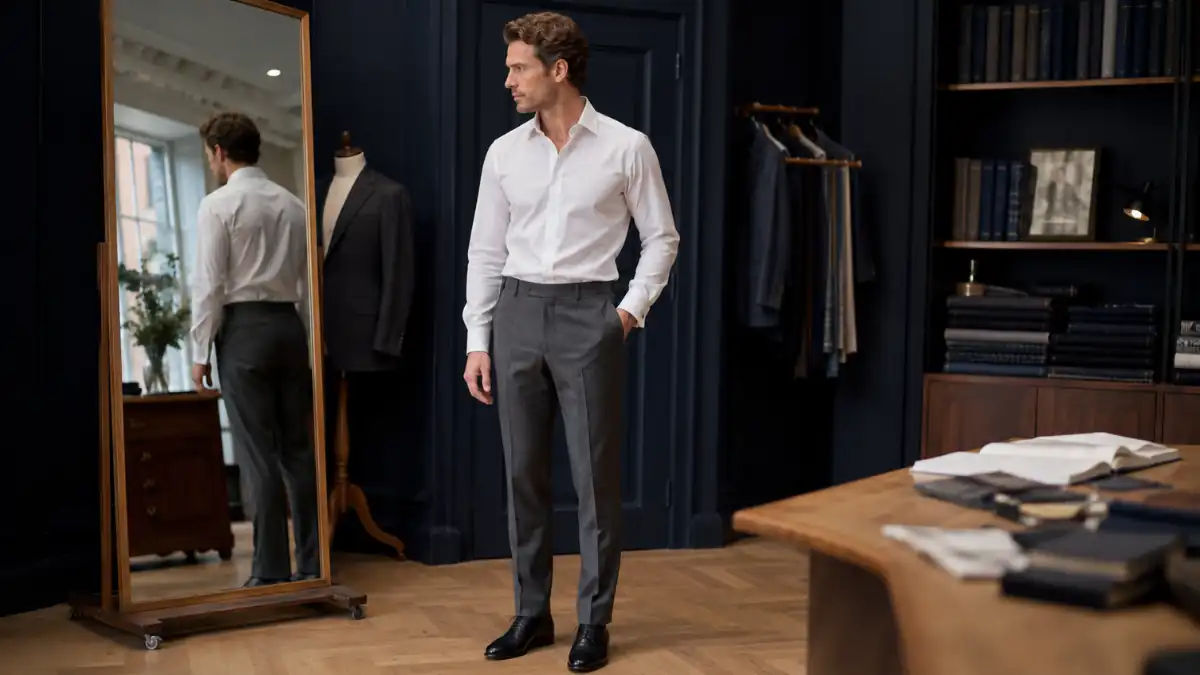
Tailored trousers should sit securely at your natural waist, follow the shape of your seat without pulling and fall cleanly through the leg. They should feel comfortable when you stand, walk and sit, while maintaining a balanced silhouette from every angle.
- Waist: secure without needing a tightly fastened belt.
- Seat: smooth and shaped, with no sagging, pulling or deep horizontal creases.
- Rise: high enough to feel comfortable and keep the waistband in position.
- Thigh: enough room for movement without excessive loose cloth.
- Leg line: clean and balanced rather than tightly moulded to the body.
- Hem: finished with a deliberate break that suits the cut, footwear and occasion.
The best fit is not automatically the slimmest fit. Instead, a skilled tailor balances comfort, proportion and clean lines around your individual posture and body shape.
Unsure whether your trousers fit as they should?
Our team can assess the balance, comfort and proportions of your trousers and explain which adjustments would make a genuine difference.
How should tailored trousers fit overall?
Tailored trousers should create a clean, uninterrupted line from the waistband to the hem. However, that does not mean they should cling closely to every part of your body. Good tailoring allows enough room for natural movement while controlling excess fabric through careful cutting, shaping and pressing.
When you look in the mirror, the waistband should appear level, the side seams should hang vertically and the creases should run down the centre of each leg. From behind, the cloth should follow the seat smoothly before falling towards the floor without twisting.
Comfort is equally important. You should be able to sit, walk and climb stairs without the waistband cutting into you or the fabric pulling tightly across your thighs. Nevertheless, comfort should not depend on wearing trousers several sizes too large. A well-cut pair creates room in the correct places.
Signs that the overall balance is correct
- The waistband remains level rather than dipping at the front or back.
- The front creases sit centrally over your shoes.
- The side seams appear straight when viewed from the side.
- The pockets remain closed rather than pulling open.
- The cloth hangs cleanly without diagonal drag lines.
- You can move normally without feeling restricted.
Small creases will naturally appear when you move. Therefore, the aim is not a completely wrinkle-free garment at every moment. Instead, the trousers should return to a composed shape when you stand naturally.
How should the waist and rise of tailored trousers fit?
The waistband is the foundation of the garment. If it sits incorrectly, the seat, rise and leg line are likely to suffer as well.
Where should the waistband sit?
Traditional formal trousers usually sit close to the natural waist, which is higher than the position of many modern jeans. This placement lengthens the visual line of the leg and allows the cloth to fall more cleanly over the hips.
Contemporary designs may sit slightly lower. Even so, they should rest in a stable position rather than sliding down during the day. The correct position will depend on your proportions, posture and the style of the garment.
How tight should a trouser waistband feel?
The waistband should feel secure without causing pressure. As a practical guide, you should normally be able to place one or two fingers inside it without forcing them. However, the trousers should not be so loose that they require a tightly fastened belt to stay in place.
Side adjusters can refine the fit, while braces support trousers from the shoulders and work particularly well with a higher rise. A belt is useful with more casual tailoring, although it should complement the fit rather than compensate for an oversized waist.
What is the rise?
The rise describes the distance from the crotch seam to the top of the waistband. It determines where the trousers sit and how much room they provide through the body.
- Low rise: sits closer to the hips and creates a more casual appearance.
- Mid rise: offers a versatile balance for business and smart-casual clothing.
- High rise: sits nearer the natural waist and creates a longer, more traditional leg line.
A rise that is too short may pull uncomfortably at the crotch and create tight horizontal folds. Conversely, an excessively long rise can leave loose fabric hanging below the seat. The correct choice is shaped around your body rather than selected solely according to fashion.
How should tailored trousers fit across the seat?
The seat should look smooth and gently shaped. It should not appear completely flat, nor should the fabric hang like a loose curtain. A skilled cutter allows enough room for your shape and posture while keeping the back line controlled.
Signs that the seat is too tight
- Horizontal lines stretch across the back.
- The pockets pull open or gape.
- The centre-back seam appears strained.
- The cloth catches beneath the seat.
- Sitting feels restrictive.
Signs that the seat is too loose
- Excess fabric gathers below the waistband.
- The back looks deflated or baggy.
- Vertical folds hang beneath the seat.
- The trousers lose their shape after a short period of wear.
Posture plays an important part here. Two gentlemen with similar waist measurements may need very different patterns because one stands upright while the other has a more forward or relaxed stance. Bespoke cutting accounts for these differences rather than relying on a standard block.
The Savile Row Bespoke Association explains that a true bespoke garment is created from an individually made pattern and developed through a series of fittings. You can read more about the craft through its official explanation of the Savile Row process.
How should the thigh, knee and leg line fit?
The upper leg needs enough room to move without allowing the cloth to balloon. When standing naturally, you should be able to pinch a modest amount of fabric at the front or side of the thigh. The precise allowance will vary according to the cut and cloth.
How should tailored trousers fit through the thigh?
The fabric should skim the thigh rather than grip it. Tightness commonly reveals itself through diagonal creases running from the crotch towards the outer thigh. In addition, the pockets may open because the cloth is being pulled sideways.
Extra room is especially important for gentlemen with athletic thighs. Simply buying a larger waist size is rarely the ideal answer because it creates unnecessary looseness elsewhere. Instead, the pattern should provide greater width through the thigh while remaining shaped at the waist.
How should the knee be positioned?
The knee line should correspond with your natural knee rather than sitting noticeably above or below it. Its position influences how the lower leg tapers and how the trousers respond when you walk.
A narrow knee creates a sharper taper, whereas a fuller knee produces a straighter, more relaxed silhouette. Neither is automatically superior. The right proportion depends on your frame, footwear and the formality of the outfit.
How long should tailored trousers be?
Trouser length is one of the most visible fit decisions. It affects whether the garment looks crisp, traditional, relaxed or untidy.
The “break” is the fold created where the front of the trouser meets the shoe. Its depth should be intentional and consistent with the width of the hem.
No break
A no-break finish ends close to the top of the shoe without creating a visible fold. It gives a clean, contemporary appearance and works particularly well with a narrow or tapered leg.
However, the hem must not be so short that a large area of sock is exposed whenever you stand. The rear should still meet the shoe neatly.
Slight break
A slight break creates one restrained fold at the front. It is perhaps the most versatile choice because it works with business suits, separate trousers and many body types.
Full break
A full break leaves more fabric resting on the shoe. It can suit a wider, traditional leg, although too much length causes stacking around the ankle and makes even a fine garment look poorly fitted.
Should the back be longer than the front?
Many formal trousers are finished with a slanted hem. The front remains clean over the shoe, while the back extends slightly lower towards the heel. This can create a polished line without requiring excessive cloth at the front.
Tailored trousers vs slim fit, tapered, straight and wide-leg styles
“Tailored” describes construction and fit rather than one fixed silhouette. A pair may be slim, tapered, straight or generously cut while still being properly shaped for its wearer.
Slim-fit trousers
Slim-fit trousers sit closer through the seat, thigh and lower leg. They suit gentlemen who prefer a sharper modern line, provided the fabric does not strain. Slim should mean controlled, not restrictive.
Tapered trousers
A tapered cut provides room through the seat and thigh before narrowing towards the ankle. It is often flattering because it combines comfort with definition.
Straight-leg trousers
A straight leg maintains a more consistent width from the knee to the hem. It creates a classic line and balances larger frames, substantial footwear and traditional jackets particularly well.
Wide-leg trousers
Wide-leg tailoring uses controlled volume rather than simple looseness. The waistband and seat must still fit correctly; otherwise, the result appears oversized rather than elegant.
Tailored trousers vs chinos
Chinos are usually made from cotton twill and tend to have a more casual construction. Formal trousers are commonly pressed with a centre crease and may include finer waistband construction, lining, pleats or side adjusters.
Consequently, chinos are useful for relaxed outfits, while well-cut formal separates provide a more refined option for business, evening and ceremonial wear.
Would a different cut improve your silhouette?
We can help you compare rises, pleats, leg widths and finishing options before your cloth is cut.
Common tailored trouser fitting problems
Creases provide useful clues, although they must be read in context. One fold may have several possible causes, so alterations should be assessed by someone who can see the complete garment on your body.
Pockets that flare open
Gaping side pockets often indicate insufficient room across the hips or thighs. They may also appear when the rise or front balance is incorrect.
Diagonal lines beneath the seat
These lines may suggest that the back balance does not suit your posture. Depending on their direction, the trousers may require changes to the seat angle, crotch shape or distribution of cloth.
Fabric collecting at the ankles
Bunching commonly means the garment is too long. However, a very narrow lower leg can also prevent the fabric from falling freely over the calf and shoe.
A waistband that dips at the front
This may happen because the rise is unsuitable, the waist is too loose or the wearer’s posture has not been considered. Tightening a belt may hide the problem temporarily, but it rarely corrects the balance.
Twisting seams
Side seams that rotate towards the front or back can indicate a cutting or balance issue. Occasionally, cloth movement or poor pressing also contributes.
A tight crotch
A short rise or insufficient crotch extension can create discomfort and pulling. Letting out the waist alone will not necessarily solve it because the shape of the pattern may need attention.
Can tailored trousers be made bigger, smaller or longer?
Many trousers can be adjusted, but the possibilities depend on how much allowance was left inside the seams and waistband.
Alterations that are commonly possible
- Taking in or letting out the waist.
- Reducing excess fabric through the seat.
- Narrowing the thigh or lower leg.
- Shortening or lengthening the hem.
- Adjusting the trouser break.
- Refining the position of the waistband.
Alterations that may be more limited
- Creating substantial extra room where little seam allowance remains.
- Changing a very low rise into a genuinely high rise.
- Correcting a severely misplaced knee line.
- Rebuilding the entire crotch shape.
- Lengthening trousers when no extra cloth is available beneath the hem.
Traditional bespoke construction often leaves additional cloth inside key seams so future adjustments remain possible. The Savile Row Bespoke Association describes trouser waistbands and side seams with inlays specifically intended to support alteration.
Its glossary of traditional tailoring terminology also provides useful context for gentlemen who want to understand the language used during fittings.
How cloth affects tailored trouser fit and drape
Fit cannot be separated from fabric. A pattern cut in firm cavalry twill behaves differently from the same pattern made in lightweight tropical wool.
Worsted wool
Worsted wool is widely used for business and formal clothing because its smooth yarns create a clean surface and defined drape. The Woolmark Company notes that worsted processing produces smoother fabrics commonly used in traditional tailoring.
You can learn more through Woolmark’s guidance on wool suiting and tailoring.
Flannel
Flannel has a softer surface and usually produces a fuller, more relaxed line. It is particularly attractive in cooler weather, although its softness can make extremely tight cuts less forgiving.
High-twist and tropical wool
These fabrics are useful in warmer conditions. They tend to resist creasing and allow air to circulate, making them suitable for travel and summer business wear.
Cotton and linen
Cotton gives a crisper, more casual appearance, while linen offers excellent warm-weather comfort and a naturally rumpled character. Neither should be judged by precisely the same wrinkle standards as a smooth worsted cloth.
Stretch fabrics
A small degree of stretch can improve comfort. Nevertheless, elasticity should not be used to disguise poor cutting. The underlying waist, rise and seat proportions still need to be correct.
Fabric labels should identify fibre composition accurately. For further background, the UK Government publishes official textile-labelling guidance.
How to check tailored trousers step by step
Use the following process during a fitting or when assessing a newly purchased pair. Stand naturally and avoid holding your stomach in or changing your usual posture.
Tailored trouser fitting checklist
| Step | What to check | What good fit looks like |
|---|---|---|
| 1 | Waistband | Level, secure and comfortable without heavy belt pressure. |
| 2 | Rise and crotch | No pulling, sagging or intrusive pressure. |
| 3 | Seat | Smoothly shaped with no deep horizontal or vertical folds. |
| 4 | Pockets | Lie flat rather than flaring open. |
| 5 | Thighs | Skim the body while allowing walking and sitting. |
| 6 | Creases and seams | Run straight without twisting around the leg. |
| 7 | Hem and break | Meet the shoe cleanly with the chosen degree of break. |
| 8 | Movement | Remain comfortable when sitting, walking and using stairs. |
Afterwards, view the trousers from the front, side and back. A photograph can reveal balance problems that are difficult to notice when looking down at your own clothing.
How to wear tailored trousers well
The cut should relate to the rest of your outfit. Trousers never exist in isolation, so consider the jacket length, shirt proportions, footwear and occasion.
With a matching suit jacket
Matching garments should share a coherent silhouette. A structured jacket usually sits best with a clean, purposeful trouser line, while softer tailoring can accommodate a little more ease.
Our guide to evaluating the complete suit silhouette explains how the jacket, sleeves, collar and trousers should work together.
With a blazer or separate jacket
Separate trousers can be paired with a navy blazer, textured sports jacket or lightweight summer coat. Aim for contrast rather than an almost-matching combination, which can look accidental.
With a tailored shirt
A cleanly fitted shirt supports the trouser line by reducing bunching around the waistband. Read our guide to shirt fit, fabric and construction for more detail.
With loafers, trainers or formal shoes
Loafers work particularly well with a neat hem and little break. Oxford or Derby shoes suit traditional business proportions, whereas minimalist trainers can complement contemporary separates.
However, formal trousers worn with trainers should still look intentional. Clean footwear, a restrained leg opening and an appropriate cloth help maintain balance.
With pleats
Pleats create room through the front and can improve comfort for larger or athletic thighs. Forward pleats open towards the fly, while reverse pleats open towards the pockets. Either can look elegant when the waistband, rise and drape are correct.
Ready-to-wear, made-to-measure and bespoke trouser fit
Ready-to-wear
Ready-to-wear garments are cut to standard sizes. Alterations can improve the waist, length and leg width, although they cannot always correct the underlying balance.
Made-to-measure
Made-to-measure normally adapts an existing pattern using your measurements and selected style options. It offers greater personalisation than standard sizing but remains based on a pre-existing block.
Bespoke
Bespoke tailoring begins with an individual pattern and develops through fittings. This allows the cutter to account for posture, asymmetry, leg shape and personal preference in a much more detailed way.
For a broader explanation, read our examination of genuine bespoke craftsmanship and our complete introduction to commissioning a bespoke suit.
FAQs: tailored trousers and correct fit
What are tailored trousers?
They are trousers designed with a structured, considered cut rather than the casual construction associated with jeans or joggers. They may be ready-to-wear, made-to-measure or bespoke. Typical details include a shaped waistband, pressed creases, side adjusters, pleats, refined pockets and carefully finished hems.
Should tailored trousers be tight?
No. They should follow your shape without gripping it. A close silhouette may be appropriate, but the pockets should remain flat, the cloth should not strain and you should be able to sit and walk comfortably.
How should tailored trousers fit at the waist?
The waistband should sit level and remain securely in place without requiring a tightly fastened belt. It should feel comfortable while standing and sitting, with a modest amount of breathing room.
Where should tailored trousers sit?
Many traditional pairs sit at or close to the natural waist. Modern styles may sit slightly lower. The correct position is the one that supports the garment securely and creates balanced proportions for your torso and legs.
How much break should formal trousers have?
A slight break is a versatile choice for most gentlemen. Narrow contemporary cuts may suit no break, while wider traditional trousers can carry a fuller break. The hem should never collapse into several untidy folds.
Can a tailor make trousers bigger?
Often, yes, particularly at the waist and seat. However, the amount depends on the cloth left inside the seams. Substantial enlargement may not be possible if the garment was made with minimal allowance.
Can a tailor make trousers smaller?
Waist, seat and leg width can commonly be reduced. Nevertheless, very large alterations may disrupt the pockets, pleats, rise and overall balance. In such cases, recutting or replacing the garment may provide a better result.
Can tailored trousers be made longer?
They can be lengthened when sufficient cloth remains beneath the existing hem. The previous fold may sometimes leave a faint line, so the tailor should inspect the fabric before proceeding.
How much do tailored trousers cost?
Prices vary considerably according to cloth, construction, location and whether the garment is ready-to-wear, made-to-measure or bespoke. Rather than comparing headline prices alone, ask what the service includes, how many fittings are provided and whether future adjustments are allowed for.
How long does it take to have trousers tailored?
A straightforward alteration may be completed relatively quickly, while a garment made from scratch requires cutting, construction and fitting appointments. The exact timescale depends on the tailoring house, complexity and season, so it is sensible to enquire well before a wedding or important event.
Can tailored trousers be machine washed?
Care depends on the cloth and internal construction. Follow the garment’s care instructions rather than assuming all pairs can be washed in the same way. Wool tailoring is frequently professionally cleaned, while certain cotton or washable blends may allow gentler home care.
Are tailored trousers worth it?
They can be a worthwhile investment when the cloth, construction and fit suit your needs. A well-balanced pair is versatile, comfortable and easier to combine with jackets, shirts and knitwear than an attention-seeking design that only works for one occasion.
Still deciding which trouser style suits you?
We will explain the practical differences between rises, pleats, cuts and cloths without pushing you towards an unsuitable fashion trend.
Next steps and useful tailoring guides
Trouser fit forms part of a wider silhouette. These related guides will help you understand how individual garments should work together:
- How Should a Suit Fit? The Complete Gentleman’s Guide
- What Makes a Truly Bespoke Suit? A Gentleman’s Guide to Real Tailoring
- Bespoke Suits Explained: A Complete Guide for Modern Gentlemen
- Tailored Shirts: The Complete Guide to Fit, Fabric and Style
- Correct waist fit Secure and level without being restrictive or depending on a tightly fastened belt.
- Correct seat fit Smoothly shaped with no sagging, pulling or deep horizontal creases.
- Correct thigh fit Enough ease for walking and sitting while maintaining a controlled line.
- Correct leg line Centred creases and straight side seams without twisting around the leg.
- Correct length A deliberate no-break, slight-break or full-break finish suited to the hem width and footwear.
- Most useful fitting test Stand, walk, sit and use stairs while wearing the shoes and shirt intended for the finished outfit.
- Key principle The best fit is balanced and comfortable, not simply as narrow as possible.
Need a professional opinion? Contact Stunning Fashion to discuss your preferred fit and occasion.
Trusted tailoring and textile references
These independent resources provide further information about bespoke construction, tailoring terminology, suiting cloth and textile labelling:
- Savile Row Bespoke Association — the traditional bespoke process
- Savile Row Bespoke Association — tailoring terms and definitions
- The Woolmark Company — wool suiting and tailoring
- GOV.UK — official guidance on textile fibre labelling
Finding the right tailored trouser fit for you
A good pair of trousers should make you feel composed rather than constrained. The waistband should remain stable, the seat should appear smooth and the legs should fall cleanly towards your shoes. At the same time, you should have enough room to move naturally throughout the day.
Fashion can influence leg width, rise and break, but proportion should remain the priority. A style that flatters one gentleman may not suit another because posture, height, build and personal preference all affect the finished line.
For that reason, our team begins by understanding how you dress, where you will wear the garment and how you prefer it to feel. We can then recommend a balanced cut, suitable cloth and practical finishing details rather than applying one standard silhouette to every client.
Ready to commission trousers that fit properly?
Speak with Stunning Fashion about your measurements, preferred silhouette, cloth and occasion. Our advice is calm, personal and focused on creating a garment you will genuinely enjoy wearing.
