Share this post:
Quick summary: Tailor vintage trousers for a better fit
If you want to tailor vintage trousers, the aim is not simply to make them smaller or shorter. A good alteration should preserve the original character of the trousers while improving the way they sit at the waist, seat, thigh and hem.
- Start with the waist and seat: these determine whether the trousers feel secure without pulling or sagging.
- Check available seam allowance: older trousers may contain useful inlay, but this should never be assumed before the garment is opened and inspected.
- Alter proportion carefully: aggressive tapering can spoil the wider leg line that often gives vintage trousers their distinctive appearance.
- Inspect the cloth first: age, previous alterations, moth damage, weakened seams and fragile fabric can all limit what is sensible.
- Fit them with the shoes you intend to wear: trouser length and break should be judged as part of the complete silhouette.
In many cases, relatively modest alterations can transform a vintage pair. However, the best result comes from balancing modern comfort with the original cut rather than forcing an older garment into a completely different shape.
Found a beautiful pair of vintage trousers that does not quite fit?
A thoughtful alteration can improve comfort and proportion without losing the character that made the trousers worth buying in the first place.
How to tailor vintage trousers without losing their character
Vintage trousers often look appealing precisely because they were cut differently from many modern pairs. Higher rises, fuller thighs, pleats, wider legs and deeper turn-ups can all contribute to their distinctive shape. Therefore, successful alteration is usually about refinement rather than reinvention.
Before changing anything, we recommend judging the whole silhouette. Look at how the waistband sits, how the cloth falls over the seat, whether the thighs have enough room and how the leg line continues towards the shoe.
That approach reflects traditional bespoke thinking. The Savile Row Bespoke Association describes bespoke garments as being shaped through specialist cutting, fitting and construction rather than simply reduced to a set of measurements. Its description of traditional construction also notes that extra cloth may be left within certain seams so a garment can sometimes be adjusted later. Read about traditional Savile Row bespoke standards.
For a broader explanation of proportion, drape and break, see our gentleman’s guide to achieving the right fit.
What to check before altering vintage trousers
With contemporary trousers, an alteration often begins with fit. With vintage clothing, condition comes first. Older cloth may have been worn, repaired, pressed repeatedly or altered by previous owners, so the tailor needs to understand what the garment can safely tolerate.
Inspect the fabric and construction
Look closely at the waistband, crotch, seat, side seams and hems. These are common stress areas, particularly if the trousers have already been let out or taken in.
- Check for moth holes, thinning wool or weakened fibres.
- Look for old stitch marks that suggest previous alterations.
- Inspect the hem for permanent wear or fading.
- Check whether the lining or pocketing has become brittle.
- Identify the original fibre content where possible.
In the UK, textile labels on garments sold commercially are intended to identify fibre composition. Older clothing may have incomplete or missing labels, but where an original label survives it can help you understand the cloth before cleaning, pressing or altering it. See the UK Government guidance on textile fibre labelling.
Check the existing seam allowance
Seam allowance is the extra cloth hidden inside the garment beyond the stitching line. Traditional tailoring sometimes leaves generous inlays specifically so a garment can be adjusted later.
However, vintage trousers vary enormously. Some have ample cloth inside the waistband and seat, while others have already been let out as far as they will sensibly go.
Tailoring vintage trousers at the waist and seat
The waist is one of the most common areas to alter. If it is slightly loose, taking it in may be relatively straightforward. Letting it out depends on how much spare cloth remains inside the waistband and centre-back seam.
How should the waistband feel?
A well-fitting waistband should stay in position without needing a belt to hold it up, but it should not dig into the body. You should also be able to sit comfortably without excessive pressure across the abdomen.
With higher-rise vintage trousers, the waistband may sit close to the natural waist rather than on the hips. This can initially feel unfamiliar if you normally wear lower-rise modern trousers.
Do not judge the waist without checking the seat
If the waistband is correct but excess fabric collects beneath the seat, the rear may also need shaping. Conversely, horizontal pulling or strain across the seat usually means more room is required.
A competent tailor will therefore assess the waist and seat together rather than treating them as two completely separate problems.
The same principle applies throughout classic menswear. Our guide to balanced proportions across a complete outfit explains why one measurement should not be considered in isolation.
Should vintage trousers be tapered?
They can be, but this is where restraint matters most. Many vintage trousers were deliberately cut with a fuller leg, and removing too much width can destroy the proportion that made them distinctive.
Start at the thigh, not only the ankle
A narrow hem does not automatically create a good line. If the thighs remain very full while the lower leg is aggressively reduced, the silhouette can look unbalanced.
Instead, a tailor normally studies:
- room across the upper thigh,
- the position of the knee,
- the amount of taper below the knee,
- the width of the opening at the hem, and
- how the cloth falls while standing and walking.
Classic tailored trousers versus modern slim-fit trousers
Classic tailored trousers often allow more ease through the seat and thigh, particularly when pleats are present. Modern slim-fit trousers tend to sit closer to the leg and may taper more strongly towards the ankle.
Neither approach is automatically better. The important point is that the finished shape should suit both the wearer and the original construction.
How to alter vintage trouser length and break
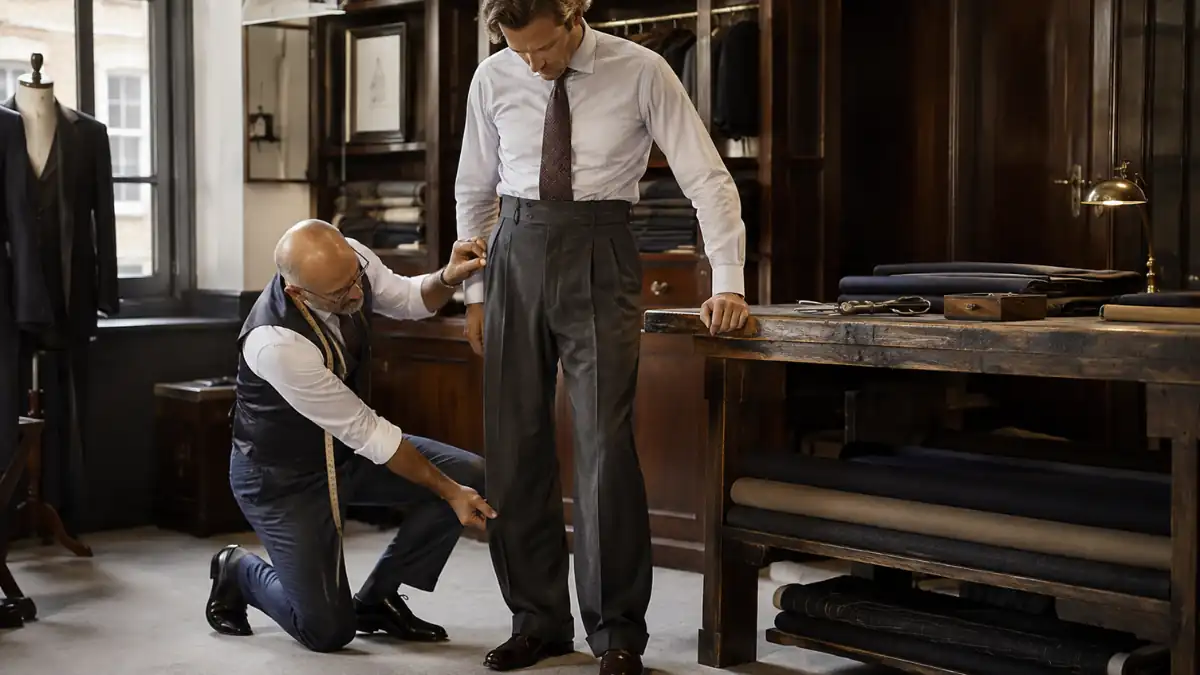
Shortening trousers is usually one of the least invasive alterations, although vintage garments introduce a few extra considerations.
A tailor first checks the existing hem, whether the trousers have turn-ups, and whether fading or wear marks will become visible once the hem is moved.
Choose the break before cutting
The “break” is the small fold created where the trouser meets the shoe. A cleaner contemporary line may use little or no break, while fuller traditional trousers often work well with a slightly longer finish.
For this reason, always attend the fitting wearing shoes with a similar heel height and shape to those you intend to wear regularly.
Can the rise of vintage trousers be altered?
Sometimes, but considerably less freely than the waistband or hem. The rise affects the relationship between the waistband, crotch, seat and upper thigh, so changing it can disturb the entire balance of the trousers.
A very long rise may occasionally be reduced, but the work can involve the waistband, pockets, fly and seat seam. Increasing the rise is usually more limited because additional cloth may simply not exist in the required areas.
Therefore, if you are buying vintage trousers specifically for alteration, we would prioritise getting the rise broadly correct from the beginning.
This is similar to choosing a strong starting point with bespoke clothing. If you want to understand the distinction between creating a garment around the wearer and adapting an existing garment, our guide to different approaches to custom clothing provides useful context.
Unsure whether your vintage trousers are worth altering?
Good cloth and a strong original cut can often justify careful alteration, but some changes are more sensible than others. We can help you understand what to look for before you commit.
How to tailor vintage trousers: step-by-step fitting process
The most reliable way to approach vintage trouser alterations is to work from the largest fit issues towards the smallest finishing details.
Vintage trouser alteration checklist
- Inspect the condition. Check cloth strength, seams, lining, waistband, pockets and existing repairs.
- Establish the correct wearing position. Put the trousers where the original rise naturally wants them to sit before pinning anything.
- Assess the waist and seat. Decide whether either area needs to be taken in or let out.
- Check the thigh. Sit, walk and bend slightly to make sure there is enough room for movement.
- Review the leg line. Decide whether the existing width suits the wearer or needs subtle tapering.
- Set the length. Wear the intended shoes and agree the preferred break.
- Preserve original details. Ask whether cuffs, pleats, side adjusters and original stitching can remain intact.
- Have a final fitting. Check movement and drape once the main changes have been completed.
Traditional bespoke fitting follows a similarly progressive approach. Savile Row guidance describes later fittings as the stage where details such as trouser length, seat and drape are refined after the larger structure has been established. See Savile Row’s overview of the bespoke fitting process.
Quick costs snapshot: what affects vintage trouser alteration prices?
There is no useful single price for altering vintage trousers because a simple hem is a very different job from rebuilding the waistband, reshaping the seat and tapering both legs.
- Simple work: shortening, replacing buttons or modest waist adjustment.
- Moderate work: tapering both legs, altering the seat or rebuilding turn-ups.
- More involved work: waistband reconstruction, major rise changes, repairing damaged cloth or preserving unusual original details.
- Higher-skill work: hand finishing, matching original stitching and working with delicate or rare cloth.
The most useful quotation is one based on the actual garment. Ask the tailor to inspect it before agreeing to substantial alterations.
Common mistakes when altering vintage trousers
Making them too slim
This is perhaps the most common mistake. A vintage trouser with a strong, generous line can lose its elegance if it is narrowed simply to resemble contemporary skinny or slim-fit trousers.
Ignoring the rise
Taking in the waist cannot compensate for a rise that fundamentally sits in the wrong place. If the crotch position is uncomfortable or the waistband feels unnaturally high or low, establish whether the basic cut suits you before spending money elsewhere.
Altering fragile cloth without inspection
Very old cloth may not react like new fabric. Seams that appear sound from the outside can be weakened internally, particularly if they have been repeatedly pressed or stressed.
The Victoria and Albert Museum’s conservation guidance on historic clothing emphasises that older textiles can be vulnerable to distortion, weakened fibres and inappropriate treatment. Although museum conservation is very different from everyday tailoring, the underlying lesson is useful: treat ageing fabric cautiously rather than assuming it will tolerate modern handling. Read the V&A’s guidance on caring for historic garments.
Pressing vintage wool too aggressively
Pressing can dramatically improve the final shape, but heat and moisture should be appropriate for the cloth. Woolmark recommends checking garment care instructions and using suitable steam and temperature when pressing wool. See Woolmark’s wool-care guidance.
Vintage trousers versus modern tailored trousers
Search terms such as “classic tailored trousers men”, “tailor vintage dress pants”, “vintage corduroy pants” and “vintage linen pants” all point to the same broader issue: different fabrics and eras produce different silhouettes.
Corduroy may feel firmer and bulkier at seams. Linen can behave very differently under pressing. Traditional wool flannel may drape softly, while worsted cloth can produce a cleaner line.
Because fabric has such a strong influence on the final silhouette, it is worth understanding the material before asking for extensive reshaping. See our guide to choosing and understanding tailoring cloth for more detail.
Likewise, if you are interested in why older garments sometimes contain more allowance for adjustment, our explanation of traditional bespoke craftsmanship provides useful background.
FAQs: Tailor vintage trousers
Can trousers be altered if they are vintage?
Yes, many vintage trousers can be altered successfully. The deciding factors are the condition of the cloth, the construction, the amount of spare seam allowance and how extensive the proposed changes are.
How do you take in tailored trousers?
Waist adjustment is commonly made through the centre-back seam, although the exact method depends on the waistband construction. A tailor should also check the seat so the alteration does not create pulling, bunching or an awkward rear line.
How do you alter the waist of vintage trousers?
The waistband and centre-back seam are inspected first. If the trousers need to be made smaller, excess cloth can often be taken in. Letting them out depends on whether sufficient inlay remains inside the garment.
Can vintage trousers be made slim fit?
Often yes, within limits. However, heavily tapering a full-cut vintage pair can distort its original proportions. A subtle reduction through the thigh and lower leg usually produces a more balanced result than simply narrowing the hem.
What are tailored trousers supposed to feel like?
They should feel secure at the waist, comfortable through the seat and thigh, and free enough for normal sitting and walking. The cloth should fall cleanly rather than pulling tightly or collapsing into excessive folds.
What does tailored trousers mean?
In everyday menswear, the phrase usually refers to trousers with a structured, considered cut rather than casual elasticated or loosely shaped bottoms. Genuine bespoke trousers go further because they are cut and fitted specifically for the wearer.
How much does it cost to alter trouser length?
Hem alteration is usually among the simpler trouser adjustments, but the exact price depends on whether the trousers are plain hemmed, cuffed, lined or require hand finishing. Vintage wear marks can also make the job more involved.
Should vintage trousers have a trouser break?
There is no single correct answer. Fuller classic trousers often suit a modest break, while a cleaner contemporary look may use little or no break. The important point is that the length complements the width of the leg and the shoes being worn.
Is it worth tailoring inexpensive vintage trousers?
Sometimes. Value is not determined solely by purchase price. Good cloth, unusual construction, attractive proportions or a difficult-to-replace style may make a modestly priced vintage garment well worth altering.
Trying to decide how far to alter a vintage pair?
Start with fit, proportion and cloth condition. Small, well-judged changes often achieve more than completely recutting the garment.
Next steps & useful guides
If you are refining a classic wardrobe rather than considering one pair in isolation, these Stunning Fashion guides provide useful background:
- Understand proportion, drape and correct lower-body fit
- See how jacket and trouser proportions work together
- Learn how different cloths affect structure and drape
- Explore the workmanship behind traditional bespoke clothing
- Compare different approaches to personalised clothing
- Discover how a complete bespoke commission is created
- Best starting point Buy a pair with a broadly correct rise, seat and overall proportion. Smaller alterations are much easier than rebuilding the fundamental cut.
- Common alterations Waist adjustment, seat shaping, leg tapering, shortening and rebuilding turn-ups.
- Most important inspection Check fabric strength, seam allowance, previous alterations, moth damage and worn hems before work begins.
- Most common mistake Over-tapering a fuller vintage cut until the original proportion and character are lost.
- Harder alteration Changing the rise can affect the waistband, crotch, seat, pockets and fly, so it is considerably more involved than adjusting length.
- Fitting essential Wear the intended shoes and move naturally during the fitting so the tailor can assess length, break, seat and thigh comfort properly.
Have a vintage pair you are unsure about? Contact Stunning Fashion and tell us what you are trying to achieve.
Useful tailoring and textile references
- Savile Row Bespoke Association – traditional bespoke standards and craftsmanship
- Savile Row – guide to the traditional bespoke fitting process
- GOV.UK – official textile fibre labelling guidance
- Woolmark – practical guidance for caring for wool garments
Preserve the character while improving the fit
The best vintage trouser alteration should look as though the garment was always meant to fit you that way. The waistband feels secure, the seat hangs cleanly, the thighs allow movement and the hem works naturally with your shoes.
More importantly, the trousers should still retain the qualities that attracted you to them in the first place. That may be a higher waist, generous pleats, fuller legs, substantial turn-ups or simply the drape of an older wool cloth.
At Stunning Fashion, we favour proportion over fashion extremes. Consequently, when you tailor vintage trousers, the goal should usually be to refine the original design rather than erase it.
Want your trousers to look considered rather than merely altered?
Speak to Stunning Fashion about fit, proportion and bespoke tailoring, and we will help you understand the details that make a well-cut pair of trousers work.
